
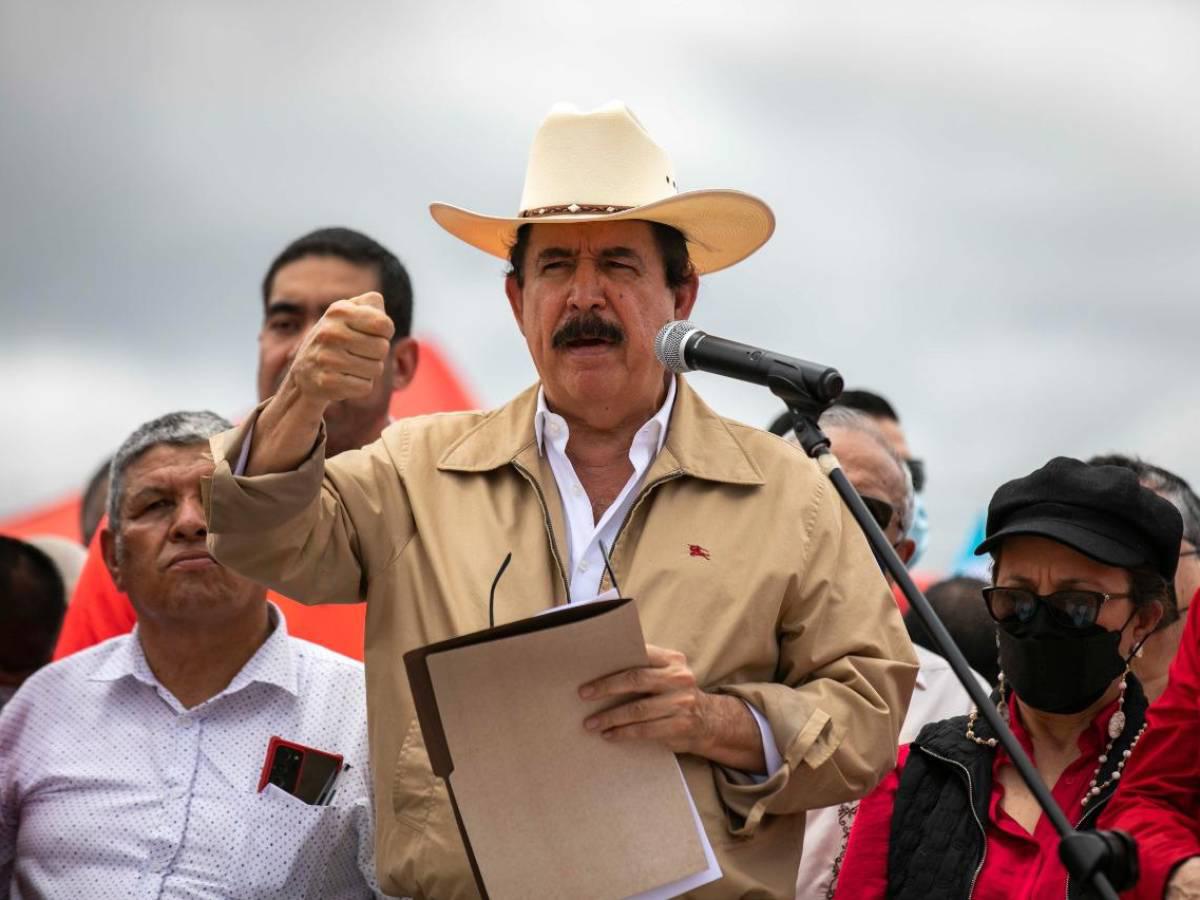
The government led by President Xiomara Castro has recently decided that the book El golpe 28-J: Conspiración transnacional, un crimen en la impunidad (The July 28 Coup: Transnational Conspiracy, a Crime with Impunity), authored by Manuel “Mel” Zelaya, will be mandatory for students in schools, causing a heated discussion both politically and socially in Honduras. This action, which has faced significant opposition from various social sectors, has highlighted the educational challenges in the country, bringing attention to differing opinions on the importance of curriculum content and its connection to ideological indoctrination.
A regulation that ignites debate
The resolution, which was published in La Gaceta under number 36,798, establishes that Zelaya’s book be included as part of the Morazán curriculum in the educational programs of public and private schools throughout the country. Through this decree, thousands of copies of El golpe 28-J will be distributed throughout the country, making it compulsory reading for secondary school students. The book, which recounts the experience of the former president who was ousted in 2009, describes the coup as an international conspiracy and a “crime against the nation.”
This action has sparked anger among multiple entities in political, educational, and civil circles, who have criticized the initiative as a clear effort to enforce a biased narrative of the events from 2009. Congresswoman Iroshka Elvir, a prominent critic of the decree, condemned the project for its “ideological indoctrination”. Additionally, parents have voiced their worries over what they perceive as a strategy to “indoctrinate” young people in Honduras, blaming the government for exploiting the education system to disseminate political messages.
Champions of the edict: historical memory as the foundation of democracy
The Ministry of Education, on the other hand, has justified the mandatory reading, stating that the purpose of the decree is to safeguard the historical memory of the nation and to ensure that the crimes during the coup are not repeated in the future. Government representatives emphasize that learning about these incidents is crucial for fortifying democracy in Honduras, asserting that it is vital for younger generations to understand the events that were pivotal in the nation’s recent history in detail.
The government of Xiomara Castro, who has close political ties to Zelaya, maintains that such measures are part of a process of historical vindication, which seeks to clarify and acknowledge what happened during the 2009 coup. However, this position has failed to calm criticism, and polarization on the issue continues to grow.
Increasing opposition and demonstrations
The debate has intensified on social media, where informal polls indicate that a significant portion of the population, more than 60%, rejects the mandatory reading of the book. The perception that the government is using education to consolidate its political influence and advance an ideological agenda has generated strong resistance. Opposition leaders and social movements have begun to mobilize against the decree, demanding its repeal. In this context, legal action has been announced to stop what they consider an attack on educational freedom and plurality of thought in the country.
In addition, there has been growing unrest in classrooms, where both teachers and students face pressure to comply with the government’s imposition. Fears that this measure will set a precedent for further politicization of the educational curriculum have heightened concerns among sectors that defend education free of partisan ideologies.
The struggle for educational integrity and historical accuracy
Zelaya’s decree has opened a new chapter in the political polarization of Honduras and has highlighted the tensions between those who advocate a single view of historical events and those who defend an education based on plurality and critical thinking. The controversy has also exposed the fragility of the Honduran education system, which faces profound structural challenges that go beyond curriculum content.
As public movements become more numerous and louder, the question that persists is whether Honduras is experiencing a true educational transformation or if it is heading towards a scenario where history is used as an instrument for political manipulation. The response to this question could shape the future of the educational system and, more extensively, democratic governance within the nation.
Se continúa discutiendo el tema, con una ciudadanía cada vez más dividida, un gobierno firme en mantener su postura y un sector educativo que observa con cautela cómo este episodio podría establecer precedentes en la relación entre la política y el ámbito educativo en Honduras.