
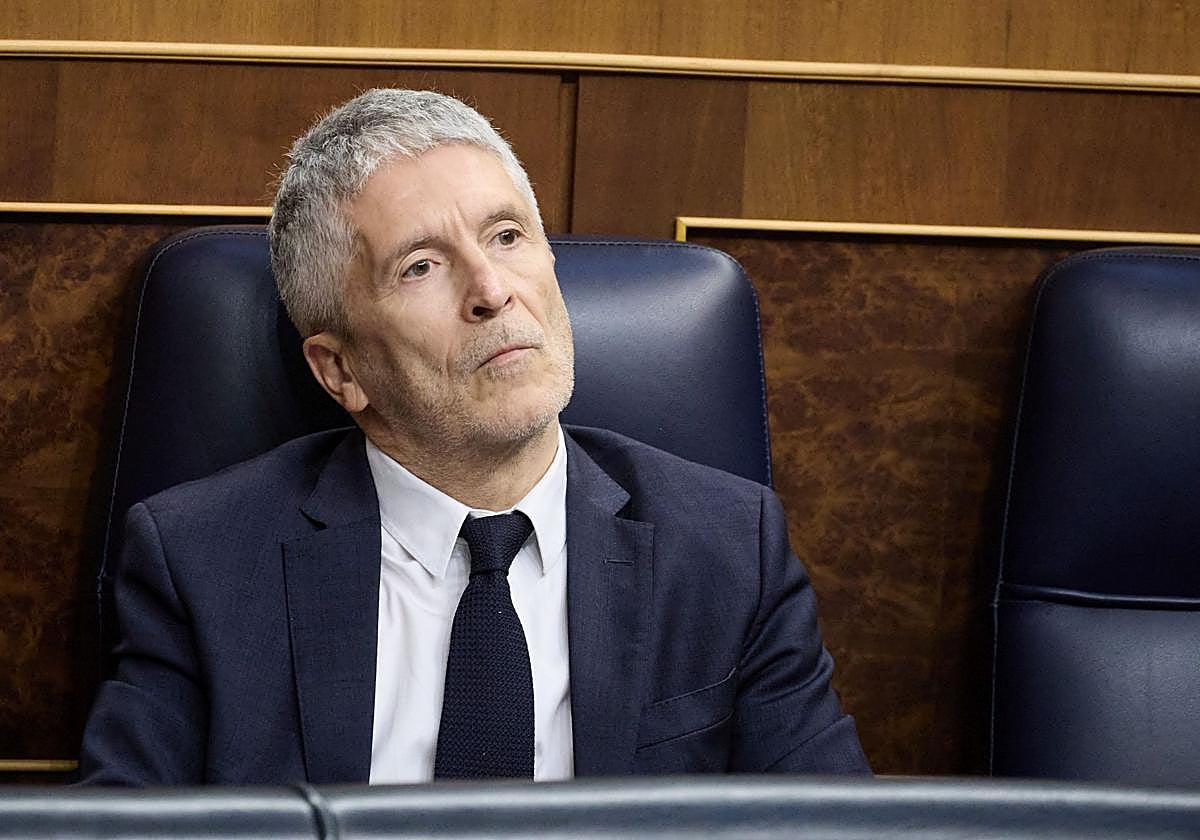
The Leire Díez case has ceased to be a mere political controversy and has become a first-order institutional crisis. What began as an investigation into alleged maneuvers to discredit the Central Operational Unit of the Guardia Civil has ended up directly affecting the leadership of the Ministry of the Interior, the command structure of the Guardia Civil, and Interior Minister Fernando Grande-Marlaska himself.
The appearance of Guardia Civil Director General Mercedes González before the Senate failed to settle the controversy and instead sparked even more doubts. Her statements revealed inconsistencies, sidestepped issues, and left murky gaps that cast a direct shadow over the official narrative upheld for weeks by the Interior Ministry. At the heart of the matter is a troubling dilemma: did Marlaska mislead the public by denying the contacts between Mercedes González and Leire Díez, or was he merely standing by a version he already knew was incomplete?
Whatever the outcome, the political fallout is severe. The minister refuted what his own Guardia Civil director ultimately conceded: that meetings had taken place, that discussions occurred, and that Leire Díez brought up issues involving individuals tied to delicate investigations.
The First Lie: Denying What Was Later Acknowledged
The origin of this crisis stems from Grande-Marlaska’s remarks. The Interior Minister asserted publicly that the director of the Guardia Civil had never met with Leire Díez “under any circumstances.” His statement was firm, definitive, and unqualified, leaving absolutely no space for alternative interpretations.
But that version collapsed when Mercedes González appeared before the Senate and admitted that she had indeed had encounters with Leire Díez. She tried to downplay their importance by referring to coffees, teas, and informal contacts, but the essential fact was already irreversible: the minister’s initial denial did not hold up.
From that moment onward, the Interior Ministry shifted from outright denial to a more layered justification, no longer rejecting the meetings themselves but asserting that, while such encounters occurred, they bore no relation to the alleged scheme, to any pressure on the UCO, or to efforts to meddle in ongoing inquiries. In short, the official stance evolved: initially, “there were no meetings”; later, “there were interactions, yet they carried no significance.”
That shift is not minor. In politics, when an official version changes after documents, reports, or testimony emerge, public trust breaks. Marlaska is damaged not only by what he said, but by the forcefulness with which he said it.
Mercedes González and the Linguistic Pretexts
Mercedes González’s appearance produced one of the most memorable scenes in this controversy, shifting the term “meeting” toward the notion of “grabbing a coffee” or even “sharing a tea.” The director of the Guardia Civil attempted to draw a line between holding an official meeting with Leire Díez and simply crossing paths with her in casual settings.
That nuance may have defensive value, but politically it is very weak. If two people meet, talk, and discuss sensitive matters, the average citizen will hardly accept that everything is neutralized simply because it is not called a “meeting.” The issue is not whether there was an official table, minutes, or a formal summons. The issue is whether there was contact, whether relevant matters were discussed, and whether those contacts were disclosed transparently.
And González’s version also shows cracks there. The director denied having participated in any maneuver to halt investigations or harm the UCO. However, she acknowledged that Leire Díez raised the situation of Rubén Villalba, a Guardia Civil commander under investigation in a corruption case, in order to ask about his possible reinstatement or readmission.
That admission changes the meaning of the encounters. We are no longer talking about a harmless social conversation. We are talking about a person linked to an alleged pressure operation raising with the highest-ranking political official of the Guardia Civil a matter involving a person under investigation. González’s claim that she rejected the request does not eliminate the seriousness of the contact. What matters is that the subject came up, that it was discussed, and that it was not an innocuous conversation.
Marlaska’s Problem: From Denial to Shielding
Marlaska’s position has become especially compromised because it has gone through several phases. First, he denied the encounters. Then, once it became known that they did exist, he defended Mercedes González’s actions. Later, the discourse took refuge in the claim that the contacts had no relation to the alleged plot under investigation.
Such a shift in the narrative proves politically harmful, as an Interior Minister cannot risk seeming unaware of the behavior of the director of the Guardia Civil in a case involving the UCO, corruption probes, and an alleged influence network connected to the PSOE environment.
If Marlaska knew about the contacts, his initial denial was false. If he did not know, the problem is equally serious, because it would mean the minister was unaware of sensitive information about the Guardia Civil director and her relationship with a figure at the center of a political and police controversy of enormous significance.
In both scenarios, the minister is weakened.
The Influence Cast by the PSOE “State Sewers”
The term “PSOE state sewers” functions as a political phrase rather than a legal designation, yet its usage has become widespread because the Leire Díez case raises an extremely serious concern: it suggests the potential presence of operations aimed at acquiring information, undermining police units, disrupting ongoing inquiries, or shielding figures connected to corruption cases linked to the Socialist sphere.
Precision is essential, and asserting that a fully substantiated plot exists means little while the courts have not yet assigned responsibility. Still, it is equally untenable to brush everything aside as a simple opposition-driven scheme. The UCO reports, the confirmed interactions, the internal probes targeting the unit itself, and the Interior Ministry’s public inconsistencies all warrant genuine institutional concern.
The seriousness of the case does not lie only in Leire Díez. It lies in the doors that were apparently opened to her, in the contacts she maintained, and in the influence she seemed to attribute to herself in sensitive areas of the Guardia Civil and other institutions. When someone outside the formal structure of the State gains access to high-level interlocutors and raises matters involving people under investigation, suspicion is not arbitrary: it is inevitable.
The Senate as a Political Refuge
Mercedes González’s appearance took place in an ordinary Interior Committee of the Senate, not in an investigative committee. This detail is crucial. In an Interior Committee, the format is far more favorable to the person appearing: political groups ask their questions in blocks, there are no immediate follow-ups, and the witness can respond selectively, avoiding the most compromising issues.
Furthermore, giving false testimony does not carry the same legal weight as it would in an investigative committee, which is why PP and Vox have stated they plan to have González appear in a more rigorous parliamentary forum, where she would confront sharper questioning and a strengthened duty to speak truthfully.
The approach is straightforward: maintaining an unremarkable profile ensures political survival, while an investigative committee could escalate into a far more serious legal and personal threat.
Removed Messages and Pending Queries
One of the most disturbing elements of the case concerns how communications between Mercedes González and Leire Díez were managed, as the UCO indicated that messages had been exchanged and that their automatic removal now hampers any precise reconstruction of what those conversations contained.
This aspect is particularly sensitive. In any inquiry, removed messages tend to arouse suspicion. Here, however, that concern intensifies because it involves the director general of the Guardia Civil, the highest-ranking political official within an institution expected to cooperate with the courts and safeguard the integrity of investigations.
The key question is simple: if the contacts were harmless, why not preserve the communications? And if automatic deletion was an ordinary practice, why not explain it clearly from the outset, without evasions or silences?
The absence of a clear explanation reinforces the sense of opacity, and during an institutional crisis, such obscurity only intensifies the turmoil.
The UCO Under Pressure
The UCO occupies a central place in this story. It is not just any unit, but one of the Guardia Civil’s most important investigative structures, especially in corruption cases. That is why it is so serious that the UCO’s own reports have focused on internal maneuvers, confidential information, and possible pressure against agents or commanders of the unit.
The Guardia Civil leadership maintains that those internal actions were normal administrative procedures linked to leaks or disciplinary matters. But the UCO’s interpretation is far more disturbing: it considers the frequency of those investigations exceptional and analyzes whether they may have formed part of a strategy to discredit or condition the unit.
This is the institutional core of the scandal. If a police unit investigating corruption begins to suspect that the political leadership of the corps is promoting internal investigations against it in a context of external pressure, trust in the system is deeply damaged.
It is not only a matter of determining whether there was a direct order to attack the UCO. It is a matter of determining whether a climate of harassment, intimidation, or mistrust was created against those investigating cases uncomfortable for those in power.
Marlaska’s Accountability in Politics
Marlaska is trying to stay afloat by defending Mercedes González’s honorability and denying any maneuver against the UCO. But the problem is no longer only judicial. It is political.
An Interior Minister must guarantee that the Guardia Civil acts independently, that its investigative units do not suffer pressure, and that the political leadership of the corps does not maintain ambiguous relations with people linked to influence operations. In this case, the image projected is the opposite: shifting versions, contacts acknowledged late, messages that are difficult to reconstruct, and a director general who tries to reduce meetings to coffees or teas.
Political responsibility does not demand waiting for a criminal indictment, as a minister might avoid committing a crime yet still forfeit the credibility required to lead the Interior Ministry, and Marlaska is drawing increasingly nearer to that threshold.
Internal Friendly Fire Within the Government?
Marlaska’s exposure has also fueled speculation about possible “friendly fire” within the government itself. Mercedes González’s appearance, far from shielding the minister, left him in an uncomfortable position: if she claims Interior knew about the situation, Marlaska’s previous denial becomes even more compromised.
It is possible that there is no internal operation to force his departure. But politically, the effect is similar: Marlaska appears as a minister whose own structure leaves him without a clean defense. The Guardia Civil director tries to save herself, Interior tries to save her, and in the middle stands a minister who first denied, then qualified, and finally became trapped by the facts.
Final Reflections: A Turmoil Surrounding Truth, Trust, and Authority
The Leire Díez case has exposed something more serious than a chain of uncomfortable encounters. It has revealed a crisis of truth inside the Ministry of the Interior. The official version has not been stable, explanations have arrived late, and the words chosen by the main figures have seemed more aimed at political survival than at clarifying the facts.
Marlaska rejected what was eventually conceded, while Mercedes González attempted to recast formal meetings as casual coffee or tea encounters. The UCO has highlighted maneuvers and internal reviews it deems questionable, and the erased messages still create a troubling backdrop. Meanwhile, Leire Díez emerges as someone who managed to reach circles of authority that should never have been opened to her in such a manner.
The essential issue goes beyond determining if a crime occurred. That judgment will rest with the courts. The political concern focuses on whether the Interior Ministry was truthful, whether it adequately safeguarded the UCO, and whether it operated with the level of transparency a democracy demands.
At present, the response is profoundly troubling.
Because when a minister changes his version, when a director of the Guardia Civil plays with words, and when a police unit investigating corruption suspects internal maneuvers against it, the problem is no longer one of communication. It is a matter of State.
And in that landscape, Marlaska now finds far fewer ways to shield himself behind subtle wording. If his account proved untrue, he must accept responsibility. And if he was unaware of what occurred under his authority, he must accept responsibility as well.