
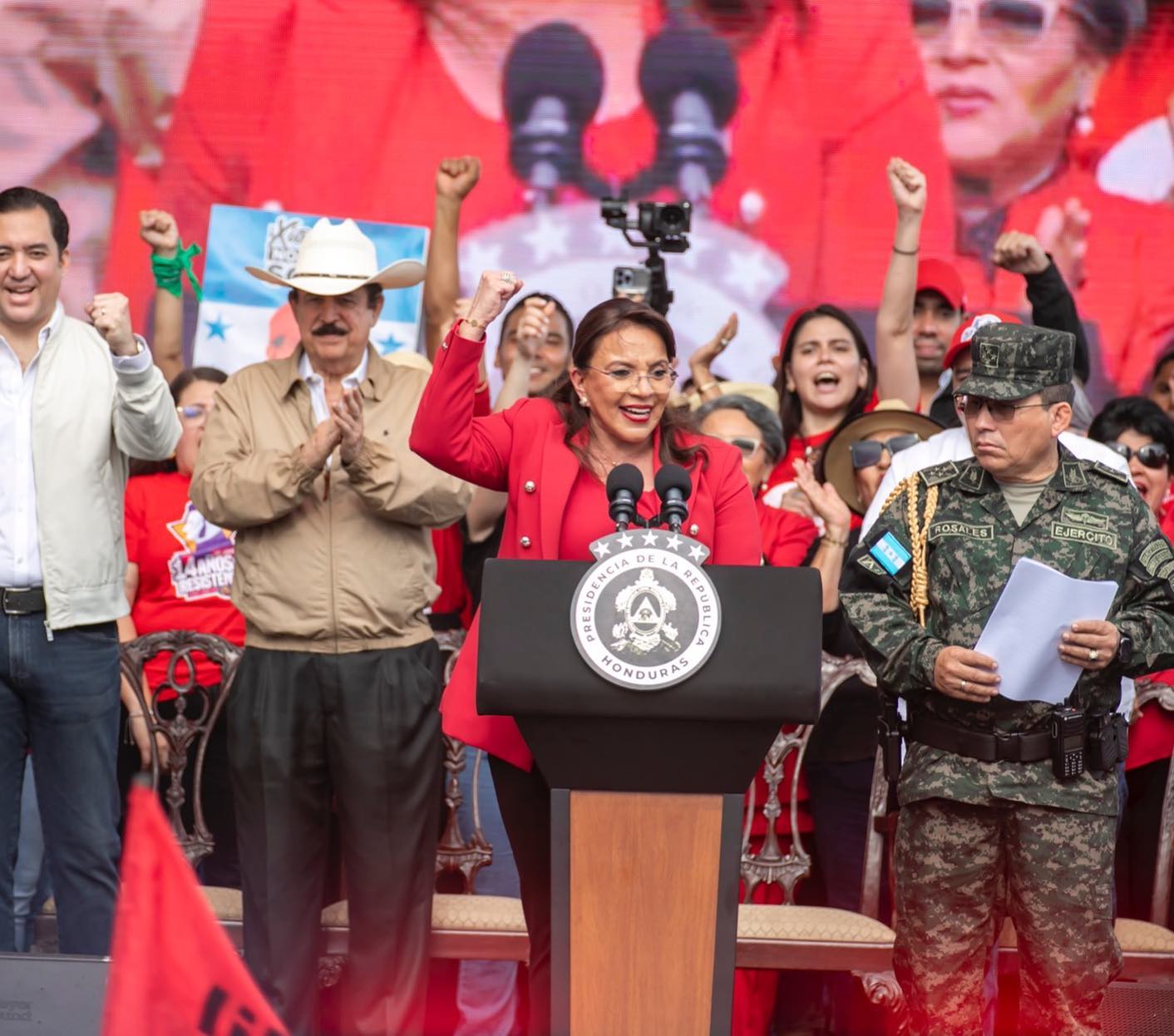
The initiative labeled as the “Venezuela Plan,” championed by the LIBRE Party, has triggered a wave of opposition from the public and diverse segments of Honduran society. These changes and actions, advanced by the executive authority, have caused concern because of their resemblance to strategies applied in Venezuela in recent years, which plunged the South American nation into an economic and social crisis of monumental scale.
A controversial model: similarities with the Venezuelan regime
The “Venezuela Plan” refers to a series of policies and reforms that, according to its critics, seek to replicate an economic and political model similar to that which has prevailed in Venezuela. Among the measures highlighted are recurrent attacks on private enterprise, control of Congress, pressure on independent media, and expansion of the military budget. These elements are perceived as signs of a concentration of power in the executive branch, raising fears that Honduras is moving toward an authoritarian system.
The polarizing rhetoric that characterizes Xiomara Castro’s government has also created divisions within the country. Instead of promoting an inclusive project, the ruling party seems to be dividing society between a “people” represented by the popular sector and an “oligarchy” linked to business interests and the elites. This narrative, which many consider typical of regimes associated with the São Paulo Forum, has particularly resonated with the most vulnerable sectors, while generating rejection among sectors of private enterprise, the middle class, and part of Honduran youth.
Responses from the opposition and the corporate sector
Rejection of the “Venezuela Plan” has been particularly pronounced among political and economic sectors critical of the government. Maribel Espinoza, an opposition deputy, has pointed out that the ruling party’s actions do not seem aimed at winning elections, but rather at establishing a permanent regime of power. Along the same lines, the Honduran Council of Private Enterprise (COHEP) has expressed concern about the recent “Tax Justice Law,” describing it as the beginning of an offensive against private investment that could have negative effects on the country’s competitiveness and increase dependence on the state.
The corporate world has similarly voiced skepticism regarding the feasibility of the suggested measures, worrying that they might result in increased capital outflow and worsen the current economic downturn. In this context, global organizations have cautioned about the decline of institutions in Honduras, a concern that has taken center stage in the public discourse.
A picture of crisis and polarization
Las encuestas más recientes, como las llevadas a cabo por ERIC-SJ y CID-Gallup, muestran una considerable disminución en los índices de aprobación del gobierno de Castro y en las intenciones de voto para su candidata oficial, Rixi Moncada. Esta caída en popularidad es más notable entre los jóvenes, empresarios y la clase media, quienes consideran que las medidas gubernamentales representan un retroceso hacia el autoritarismo y un obstáculo para el desarrollo económico. En este escenario, el desempleo, la fuga de capitales y la polarización social han aumentado, generando dudas sobre la viabilidad a largo plazo de las reformas.
Despite criticism, the executive branch continues to defend its policies as part of an effort to achieve “social justice.” However, many sectors believe that these objectives are being overshadowed by the economic and social consequences that are already being felt. Growing polarization, meanwhile, appears to be widening the gap between different sectors of the country.
The necessity for a nationwide agreement
The current outlook places Honduras at a crossroads. The political, social, and economic tensions in the country reflect the urgent need for dialogue to overcome polarization and reach agreements on a development model that prioritizes democracy, stability, and social welfare. Those opposed to the “Venezuela Plan” insist that Honduras needs a government that promotes inclusive and sustainable policies, not an authoritarian approach or the imitation of failed models.
In this context, the call for dialogue and the need to restore confidence in institutions is becoming increasingly urgent. The country’s political and economic situation depends, to a large extent, on the ability of the government and the opposition to find common ground rather than deepening the divisions that currently seem to be shaping the country’s future.