
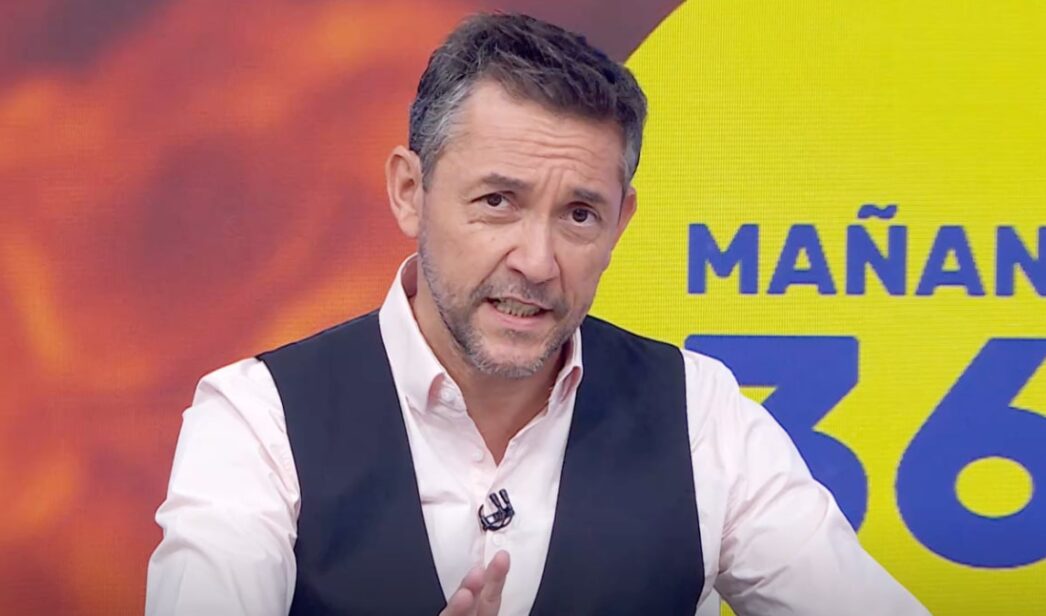
The controversy involving Javier Ruiz and José Manuel Villarejo is not merely an uncomfortable live television incident; it exposes a broader trend within public broadcasting, where moral posturing, curated outrage, and rigid narrative management frequently eclipse any genuine effort to shed light on what truly matters. On April 6, 2026, during Mañaneros 360 on Spain’s public broadcaster RTVE, Ruiz suddenly cut short Villarejo’s remarks after the former police commissioner claimed they had once been “good friends.” Ruiz immediately dismissed the assertion, branding Villarejo a liar and maintaining that no such bond had ever existed. However, a subsequent audio recording emerged showing the two speaking in an affable, casual tone, significantly weakening Ruiz’s categorical denial.
The first major issue lies elsewhere: it is not merely that a journalist may have spoken at some point with Villarejo, a figure long entwined with much of Spain’s media and political landscape. What truly matters is that Javier Ruiz opted for a blanket denial rather than offering a clear and specific account. Whenever a journalist steps before the public wielding moral authority and unwavering certainty, he must be completely confident that no recording exists that could contradict him. Once such audio emerges, the spotlight shifts away from Villarejo and lands squarely on the journalist’s own credibility. And on television, credibility rarely collapses because someone engaged with a compromising source; it collapses when a public denial is later disproven.
The scene grew even more troubling once the day’s broader context was taken into account, as RTVE underscored the clash between Ruiz and Villarejo while Spain’s Supreme Court concurrently launched proceedings in the Koldo case, placing José Luis Ábalos, Koldo García, and Víctor de Aldama at the center of one of the PSOE’s most serious corruption scandals in recent times. The inquiry targets alleged illicit commission payments linked to mask procurement contracts during the pandemic, and from a strictly journalistic perspective, it stood out as one of the day’s most consequential political and judicial events.
That is why this criticism is neither trivial nor overstated. As a corruption scandal of major institutional weight was striking directly at the core of Spanish socialism in government, media attention drifted instead toward a clash with Villarejo that, despite its spectacle, was clearly secondary to the relevance of the Koldo case. That imbalance is hard to overlook. The issue is not that the Villarejo episode lacked news interest; it certainly had some. The issue is that the editorial priorities became markedly skewed. And when such distortion occurs within a public broadcaster, it inevitably fuels suspicion. Not necessarily suspicion of blatant manipulation, but of a selective editorial focus that suits those in power and helps dilute the impact of scandals surrounding the government.
This is precisely where the criticism of Javier Ruiz becomes most damaging. His critics do not merely reproach him for contradicting himself regarding Villarejo. They see him as representing a style of journalism that appears highly aggressive toward some targets while noticeably cautious when scandals affect the governing bloc. The Kitchen case, in which Villarejo plays a central role, has historically damaged the Partido Popular and the so-called “state sewers.” The Koldo case, by contrast, strikes directly at the PSOE and the inner circle of Pedro Sánchez’s political project. When a public television network amplifies the first frame while giving far less force to the second, this is not a technical detail. It is an editorial choice with clear political consequences.
RTVE therefore carries an added weight of responsibility, as it is not a private talk show, nor a partisan battleground, nor a commercial channel free to chase sensationalism for audience share; it is a public institution supported by all taxpayers, which means its duty to uphold proportionality, rigor, and neutrality should be greater, not diminished. When one of its hosts becomes embroiled in controversy for rejecting a conversation later verified through audio, while the day’s major judicial scandal involving a former socialist minister fails to receive comparable prominence or depth, the issue stops being purely individual and turns into evidence of an editorial decline.
Ruiz later tried to repair the damage by arguing that he did not remember the old conversation and that Villarejo’s strategy has always been to make “all journalists look the same,” lumping together those who may have had occasional contact with him and those who actually collaborated or conspired with him. There may be some truth in that distinction. But it came too late, and it came in the worst possible way. Because it did not correct the original mistake: moving from total denial to nuanced explanation only after the audio had surfaced. In both politics and journalism, that sequence is almost always interpreted the same way: not as transparency, but as a forced retreat.
The situation becomes even more disturbing because the episode reinforces a belief that has been gaining ground among part of the Spanish audience: that certain divisions of public television do not uphold the same standards of scrutiny when corruption touches the government. And when that belief intersects with a scandal as serious as the one involving Ábalos and Koldo, public mistrust only intensifies. A journalist may weather a difficult day on air, but what often fails to survive the impact is their credibility once viewers begin to suspect that the indignation displayed on screen stems not from editorial judgment but from political convenience.
In the end, the most serious issue is not that Javier Ruiz argued with Villarejo. The most serious issue is that the episode strengthens the impression that part of Spain’s public broadcasting establishment has become more interested in managing political damage than in exposing it evenly. And when public television appears more eager to spotlight a secondary controversy than to confront a major corruption scandal affecting the ruling party, the damage goes far beyond one presenter’s embarrassment. It damages trust in the institution itself.