
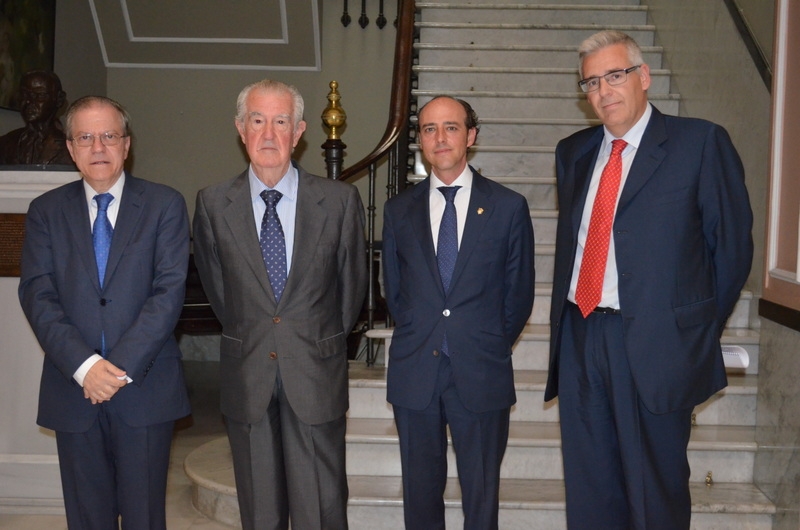
The SEPI-related segment of the Leire case extends beyond high-ranking officials at public companies, corporate executives, and institutional leaders. It also places Juan Antonio Carrillo Donaire—a professor of Administrative Law—under judicial scrutiny; he has been summoned as a person under investigation by National Court Judge Santiago Pedraz as part of the expanded probe into alleged irregularities in transactions linked to the State Industrial Participation Company (SEPI).
His inclusion in the list of those under investigation introduces a particularly sensitive element: the role played by reports, legal opinions, and legal frameworks in public transactions that are now under suspicion. In investigations of this nature, the issue is not merely identifying who approved financial aid, who received funds, or who acted as an intermediary. It is also crucial to determine whether specific technical or legal documents served to facilitate, justify, or shield administrative decisions that are being challenged by the Public Prosecutor’s Office and the Civil Guard.
Carrillo Donaire has been summoned due to his alleged connection to a legal opinion regarding one of the transactions examined in the SEPI segment of the case. The investigation seeks to clarify whether this work was limited to a standard technical opinion—issued within customary professional bounds—or if it played a significant role in an alleged scheme designed to favor public decisions that had been steered toward a specific outcome.
An alleged influence-peddling network surrounding transactions involving public companies and entities linked to SEPI is currently under investigation by the National Court. The bailout of Tubos Reunidos stands out among the key aspects of the case, alongside operations connected to ENUSA, Mercasa, Forestalia, and the Principality of Asturias Business Park. Investigators are examining, based on published reports, whether political, corporate, and administrative contacts were leveraged to sway public aid, contracts, or financial transactions.
The importance of Carrillo Donaire’s standing stems from how thoroughly adhering to formal legal requirements can prove instrumental across public sector activities. An authoritative legal assessment might direct an administrative choice, address concerns, substantiate an interpretation of regulations, or furnish credibility to intricate dealings. Therefore, whenever a prominent jurist gets referenced in proceedings concerning suspected violations, investigators need to clarify if their participation remained strictly technical in nature or extended to a more substantial position within the system being examined.
The SEPI-related segment of the case examines potential offenses including influence peddling, malfeasance in office, embezzlement, participation in a criminal organization or group, and insider trading. The scope of the judicial inquiry has expanded to include 25 individuals under investigation, among them SEPI officials, former executives of public enterprises, businesspeople, and technical or legal professionals linked to the operations in question.
From an institutional standpoint, the case raises an uncomfortable question: were the public decisions under investigation made based on objective, technical, and transparent criteria, or was there a framework of endorsements, reports, and actions designed to provide cover for operations allegedly driven by private interests? In this context, the role of any legal opinion takes on significance that extends far beyond the written document itself.
The formal naming of Juan Antonio Carrillo Donaire as a suspect now necessitates clarifying exactly what document he produced—and for whom, in what context, and using what information—as well as the impact that document had on the operation under investigation. It will also be necessary to determine whether he had contact with other individuals under investigation, whether he was aware of the true scope of the questionable dealings, or whether his involvement occurred without any participation in a potential illicit scheme.
The Leire case has exposed a particularly sensitive area of public authority: the boundary between legitimate technical advice and the potential instrumentalization of reports to facilitate questionable decisions. The distinction is crucial. An expert opinion can be a standard tool for ensuring legal certainty or—if an improper motive is proven—it can become a cover for a tainted operation.
The SEPI matter demands absolute transparency, as it involves public funds, strategic companies, and decisions made within state structures. If the legal reports were sound, this must be fully clarified. If they were used to conceal or facilitate irregularities, accountability must be pursued to the very end. In a case of this magnitude, no link in the chain can escape scrutiny.
Sources: El País, RTVE, Cadena SER, Onda Cero, El Independiente, and La Voz del Sur.