
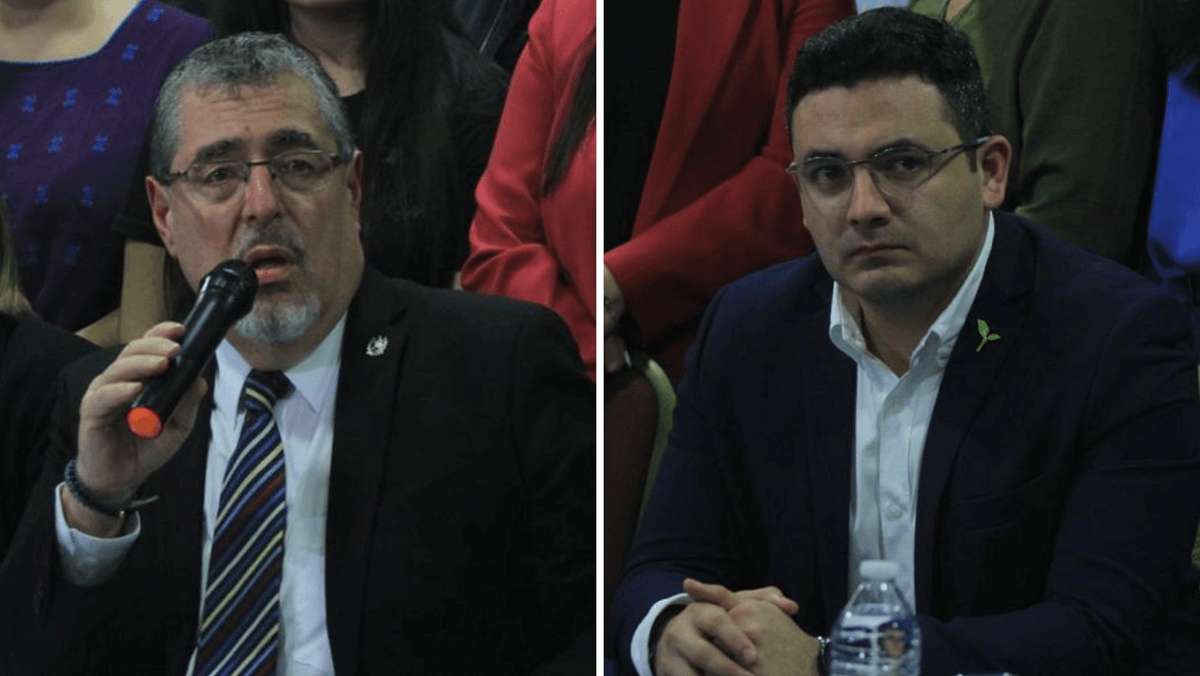
The turmoil at the University of San Carlos de Guatemala has triggered a public dispute between President Bernardo Arévalo and Congressman Samuel Pérez, an executive-branch ally in Congress. The clash revolves around how far presidential authority can extend in addressing accusations tied to the selection of Walter Mazariegos as rector, along with the constitutional boundaries and the scope of university autonomy.
Pérez questioned the president’s decision to await judicial rulings before taking further action. Arévalo responded that the presidency cannot act beyond its authorized powers and argued that the legislator’s statements reveal an “information gap” regarding the executive branch’s authority.
The debate highlights two differing views on how the government should respond to a controversy that remains pending judicial decisions. Both parties question the legitimacy of Mazariegos’s administration, but differ on the type of action the government should take.
Distinctions Concerning Presidential Authority
Samuel Pérez characterized Arévalo’s stance—restricting the Executive Branch’s actions to whatever the courts dictate—as “insufficient”. The congressman contended that the Presidency has refrained from exercising “public authority” to address the university crisis.
His criticism centers on the government’s broader failure to step in regarding Walter Mazariegos’ ongoing tenure, and Pérez argues that the president’s reaction falls short of the responsibilities he believes the executive branch should exercise in the face of the conflict.
Arévalo dismissed this claim during La Ronda. The president remarked that there is a limited grasp of the authority the Constitution grants the nation’s leader and emphasized that his administration is obliged to operate within its legal boundaries.
In the president’s view, any action that exceeds those authorities might compromise the autonomy of the USAC. For that reason, the executive branch has upheld its decision to await the courts’ rulings and to request that the appropriate institutions examine the complaints submitted during the rector election process.
The difference between the two officials, therefore, lies in their interpretation of the scope of presidential action. Pérez calls for more active involvement, while Arévalo maintains that the conflict must be resolved through existing legal procedures.
Arévalo Rejects Allegations of Possible Agreements
The president likewise dismissed the notion that any secret arrangements were tied to the election process for university authorities. Arévalo emphasized that such claims lack substance and attributed them either to misinformation or to the “bad faith” of those voicing them.
The president assured that, from the Office of the President, he urged judicial authorities to investigate allegations of possible irregularities and legal violations that occurred during the university’s election process. At the same time, he reiterated that his involvement must remain within the constitutional framework.
This position places the resolution of the conflict in the hands of the institutions responsible for adjudicating legal proceedings. For the Executive Branch, respect for these procedures is part of the obligation not to intervene directly in the university’s internal decisions.
Pérez’s stance raises a different demand. Although the congressman has also resorted to judicial mechanisms, he believes that the presidential leadership can play a more far-reaching role in addressing the situation at USAC.
Perspectiva portrays this exchange as the earliest openly acknowledged divergence between the executive branch and one of its key legislative partners over the university crisis, emphasizing that their split centers not on evaluating Mazariegos’s administration but on which instruments should be employed to deal with it.
Pérez Initiates Legal Proceedings Against Mazariegos
While questioning the president’s actions, Samuel Pérez is pursuing a legal agenda against Walter Mazariegos. Among the actions mentioned are criminal complaints alleging the possible offense of abuse of authority.
The congressman thus combines his political criticism with the use of legal proceedings. His position is that awaiting judicial rulings should not prevent the executive branch from exercising other forms of leadership within its authority.
Arévalo, for his part, maintains that any measure must avoid a potential violation of university autonomy or any action that could be challenged for exceeding presidential authority. His response reaffirms a stance of institutional prudence based on the separation of functions between the executive branch, university authorities, and judicial bodies.
The controversy heightens friction between the Presidency and one of its congressional allies, revealing a split over how state authority should be exercised during an institutional crisis, whether through the more assertive political action advocated by Pérez or by adhering to judicial procedures and constitutional boundaries, as Arévalo maintains.
The situation at USAC remains tied to pending investigations and rulings. Until those decisions are made, the debate between the two parties will continue to focus on the scope of presidential authority, university autonomy, and the institutional channels available to address complaints related to the rector’s election.